The Hidden Cost of Neglecting Struggling Developers
Most performance programs focus on top talent. But here's what they miss: lifting your bottom 25% can yield more team-wide gains than optimizing your A-players.
Consider this: A single underperforming developer can:
- Block team members waiting for code reviews
- Create technical debt that compounds over time
- Impact team morale when others pick up the slack
- Cost significant productivity across the organization
But transform that struggling developer, and you unlock compound benefits across the entire team.
The ROI of Strategic Coaching
Small wins from underperformers create cascading improvements. When a developer improves their merge request quality and starts actively reviewing peers, the whole team benefits. It's not just about individual output — it's about reducing bottlenecks, increasing knowledge sharing, and improving overall team velocity.
The Numbers That Matter
Based on industry research and documented case studies, here's the real ROI of lifting your bottom performers:
Individual Impact
- Faster cycle times — Google's DORA research shows high-performing teams have 24x faster recovery times and deploy 208x more frequently
- Reduced defect rates — IBM's research found that effective code reviews can catch up to 60% of defects
- Increased collaboration — Microsoft studies show that developers who actively participate in code reviews have 2x better code quality
Team-Wide Benefits
- Productivity gains — Atlassian reports that reducing context switching can save teams 2+ hours per developer daily
- Velocity improvements — Teams with consistent review practices see 20–30% faster delivery cycles (DORA metrics)
- Knowledge distribution — Google's engineering practices show 35% better knowledge sharing in teams with active review culture
Financial Impact
- Cost of poor performance — Industry estimates show underperforming developers can cost $100,000–250,000 annually in lost productivity
- Turnover costs — SHRM research indicates replacing a developer costs 50–200% of their annual salary
- ROI of development — McKinsey's research confirms that "improving the performance of the lowest tier can deliver higher ROI than refining elite talent"
These aren't just theoretical — they're based on real-world measurements from leading tech organizations.
Early Detection: The Action Tracker Advantage
The key to transformation? Identifying struggles early and addressing them systematically.
This is where Deventura's three-step approach becomes invaluable. Instead of waiting for formal reviews to surface problems, we provide continuous visibility and actionable guidance.
How Deventura's System Works
Step 1: Measure Against the Six Pillars
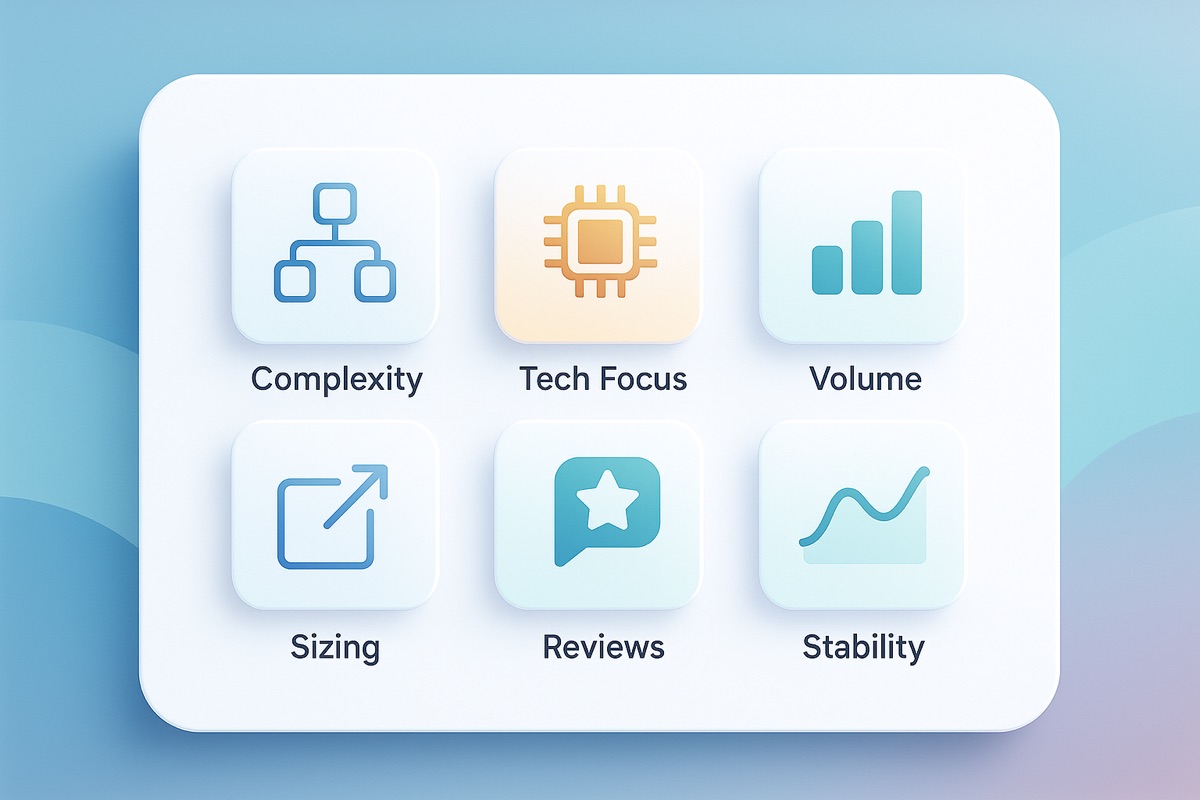
Every night, Deventura analyzes your developers' actual work patterns across our Six Pillars framework:
- Complexity Ratio — Are they tackling challenging problems?
- Tech Focus — Are they building deep expertise?
- Merge Request Volume — Is their output consistent?
- Size Balance — Are their contributions reviewable?
- Review Engagement — Are they helping teammates grow?
- Trend Stability — Are they improving over time?
Step 2: AI-Powered Personalized Suggestions
Our AI analyzes each developer's unique patterns and generates tailored recommendations:
- Specific areas where they're excelling
- Opportunities for growth based on their current trajectory
- Concrete actions that match their skill level and context
- Comparisons to team baselines to identify outliers who need support
Step 3: Action Tracker for Implementation
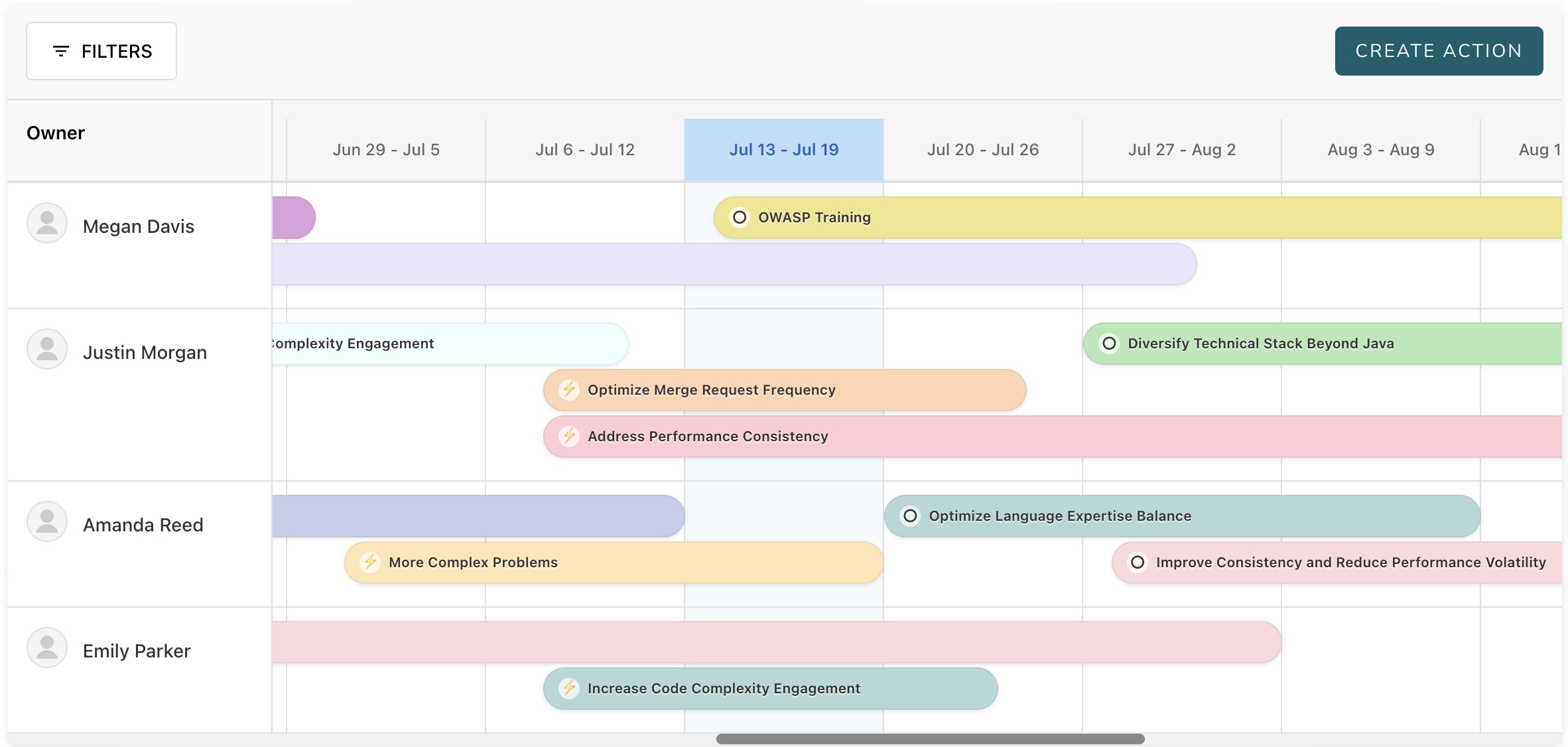
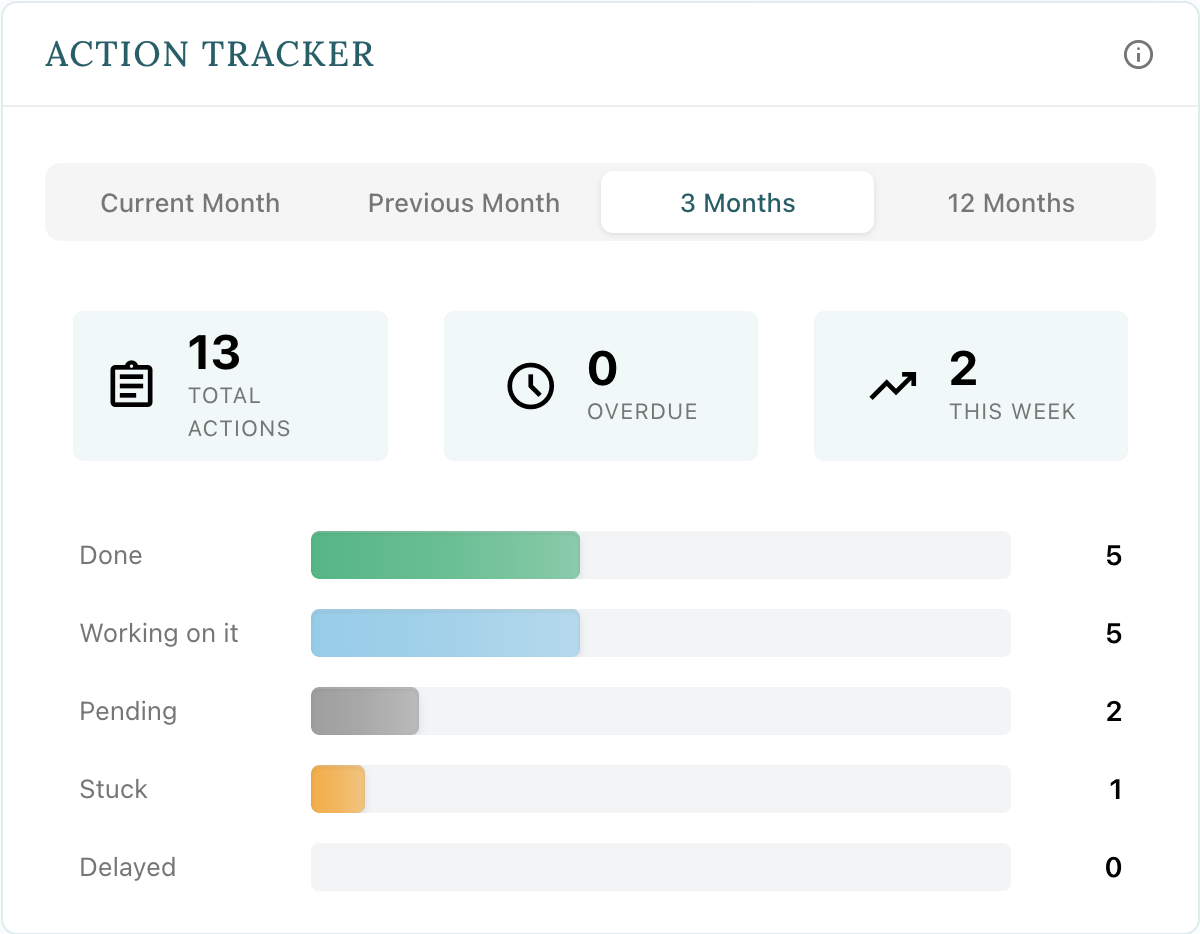
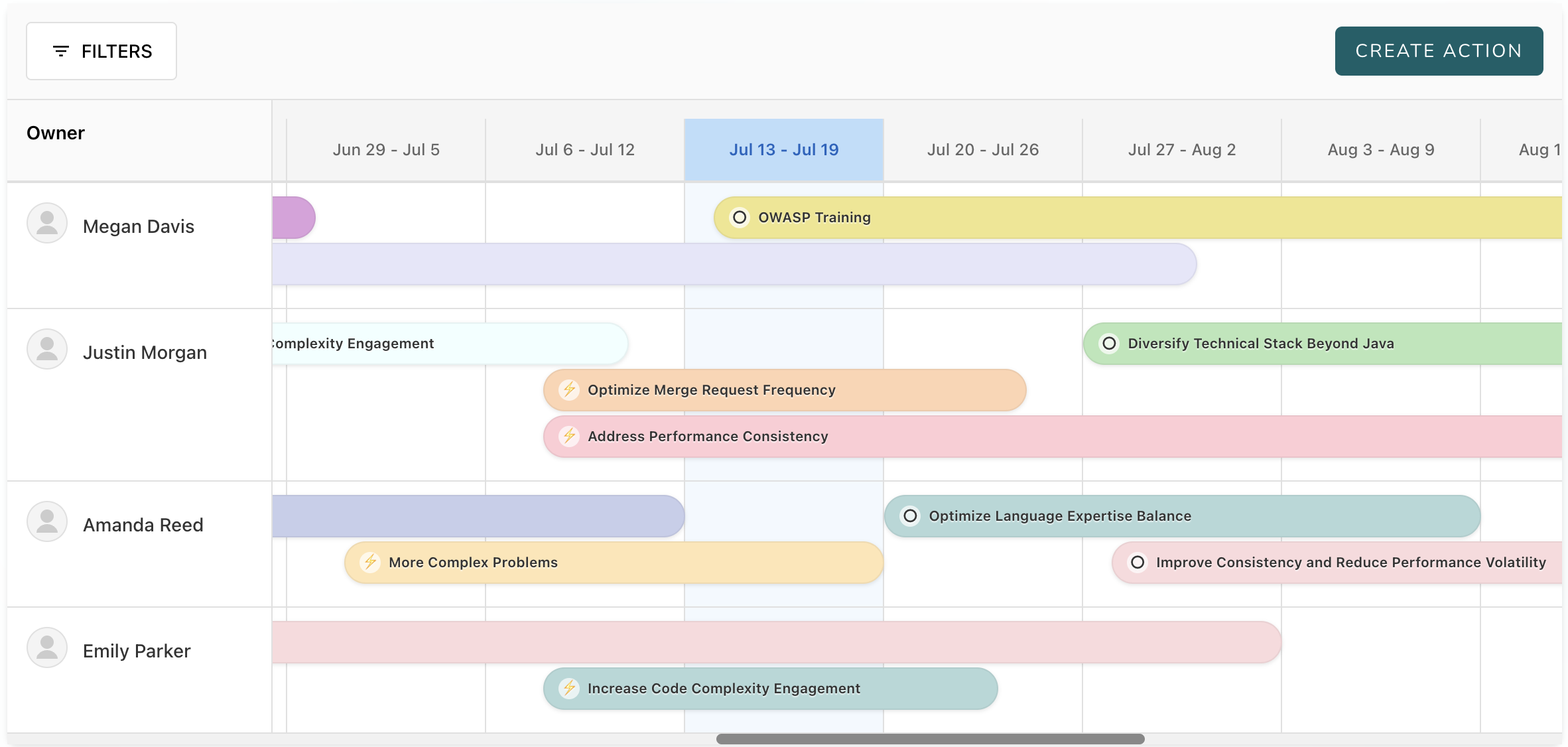
The Action Tracker turns insights into results by:
- Converting AI suggestions into trackable action items
- Monitoring progress on improvement initiatives
- Celebrating wins when developers complete actions
From Insight to Action
For example, when our AI identifies a developer struggling with code reviews:
- Six Pillars Analysis reveals low Review Engagement score (1.2 vs team average of 4.5)
- AI Suggestion generates personalized recommendation: "Start by reviewing 2 smaller Merge Requests daily in your primary tech stack"
- Action Tracker creates a trackable item, monitors progress, and celebrates when completed
This systematic approach ensures no one falls through the cracks while providing clear, achievable paths for improvement.
Real Patterns, Real Impact
Let's look at common patterns the Action Tracker helps identify:
The Isolated Developer
- Low review engagement scores
- Minimal collaboration metrics
- Often working in silos
- Action Tracker Insight: Suggests increasing code review participation and collaboration opportunities
The Overwhelmed Contributor
- Irregular delivery patterns
- Large, infrequent Merge Requests
- Declining quality metrics
- Action Tracker Insight: Recommends breaking work into smaller, manageable pieces
The Plateau Performer
- Consistent but low complexity work
- Avoiding challenging tasks
- Limited technical growth
- Action Tracker Insight: Identifies opportunities for gradual complexity increases
Building Momentum Through Visibility
The Action Tracker's power lies in making invisible patterns visible:
- For Developers: Clear understanding of their performance patterns and growth opportunities
- For Managers: Data-driven insights to guide coaching conversations
- For Teams: Transparency that builds trust and psychological safety
Where to Focus Your Coaching Energy
Based on analysis of thousands of developer patterns, here are the key areas that drive improvement:
Delivery Consistency
Irregular contribution patterns often signal deeper issues. The Action Tracker helps identify blockers preventing regular delivery, opportunities for better work breakdown, and need for clearer expectations.
Review Engagement
Code review participation is a leading indicator of team integration. Low engagement might indicate lack of confidence, time management challenges, or need for mentorship.
Technical Growth
Stagnant complexity metrics often reveal comfort zone patterns, missing skill development opportunities, or need for stretch assignments.
Collaboration Health
Team interaction patterns show communication gaps, knowledge silos, and opportunities for pair programming.
The Multiplier Effect
When you successfully support struggling developers, the benefits multiply:
- Team Confidence — Everyone sees that growth is possible and supported
- Knowledge Sharing — Former strugglers become empathetic mentors
- Retention — Developers stay when they see paths to improvement
- Culture — Creates a learning environment vs. a judgment culture
Getting Started with Deventura
The beauty of Deventura is its simplicity:
- Connect Your Repository — Deventura analyzes your existing GitLab or GitHub data
- Review Six Pillars Insights — Understand current team performance patterns
- Leverage AI Recommendations — Get personalized suggestions for each developer
- Track Progress with Action Tracker — Monitor improvement initiatives without micromanaging
No complex setup. No behavior changes required from developers. Just insights that enable better support.
The Bottom Line
Helping your lowest performers improve isn't charity — it's one of the highest-impact investments you can make. With Deventura, you can:
- Measure objectively with the Six Pillars framework to identify who needs support
- Get AI-powered insights with personalized recommendations for each developer
- Track implementation with the Action Tracker to ensure progress happens
- Build a culture of continuous growth and improvement
Every developer has potential. The question is: do you have the visibility to unlock it?