
AI coding is exploding.
Tools like Claude Code and Cursor are helping engineers write code much faster than before. Some teams even report 2 to 5x higher output on routine tasks.
But there's a catch.
We're Still Measuring the Wrong Things
We focus on tokens per second and lines of code generated, while missing what really matters: how much of that code actually ships, how good the decisions are, and whether our engineers are still growing.
It is easy to count what AI produces. It is much harder — and much more important — to ask whether that production translates into the outcomes engineering leaders are actually accountable for: delivered business value, sound architectural decisions, and engineers who keep getting better at the job.
The Pressure Is Going Up, Not Down
As AI speeds up production, measuring the right things has never been more important — or more difficult. The traditional metrics get noisier the faster code is generated. The signal you need is now buried under a much larger volume of output.
If your dashboards are tuned to reward raw output, AI will inflate them dramatically while telling you nothing about whether the team is healthier or more capable than it was last quarter.
What Better Measurement Looks Like
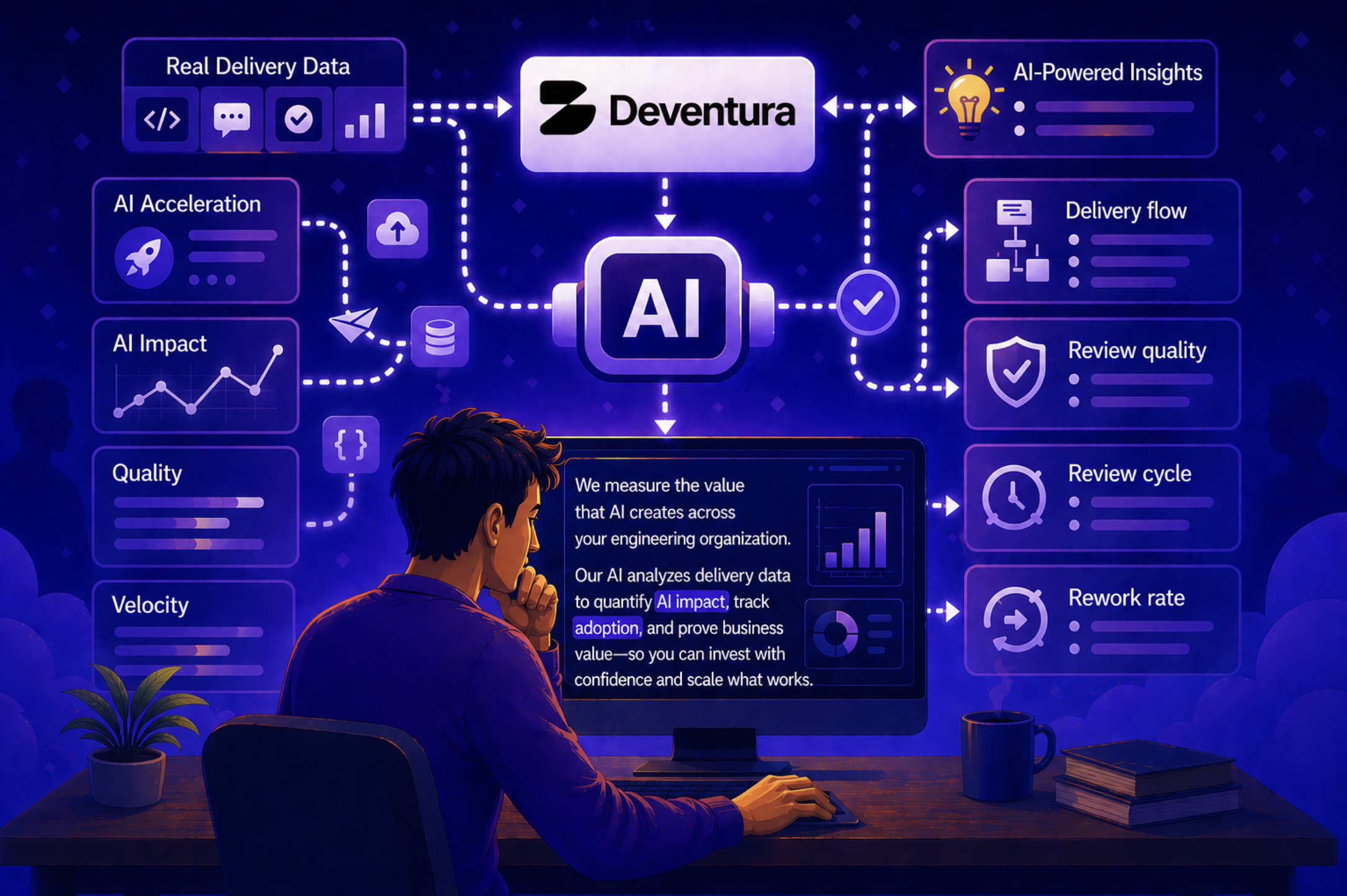
At Deventura, we help engineering leaders solve this by combining real delivery data with AI-powered insights. We measure not just how much is produced, but how well it's produced — and how it delivers business value, while supporting engineer development.
That means looking at:
- What actually ships, not what gets generated and discarded.
- Decision quality, not just code volume — are we choosing the right things to build?
- Engineer growth, so AI is augmenting your team's capability rather than quietly replacing it.
- Business outcomes, so velocity is connected to value rather than measured in isolation.
The Takeaway
AI makes us faster. The right measurements make us smarter.
The teams that combine both — speed from AI, clarity from better measurement — will be the ones that turn this moment into a durable advantage rather than a short-term productivity spike.