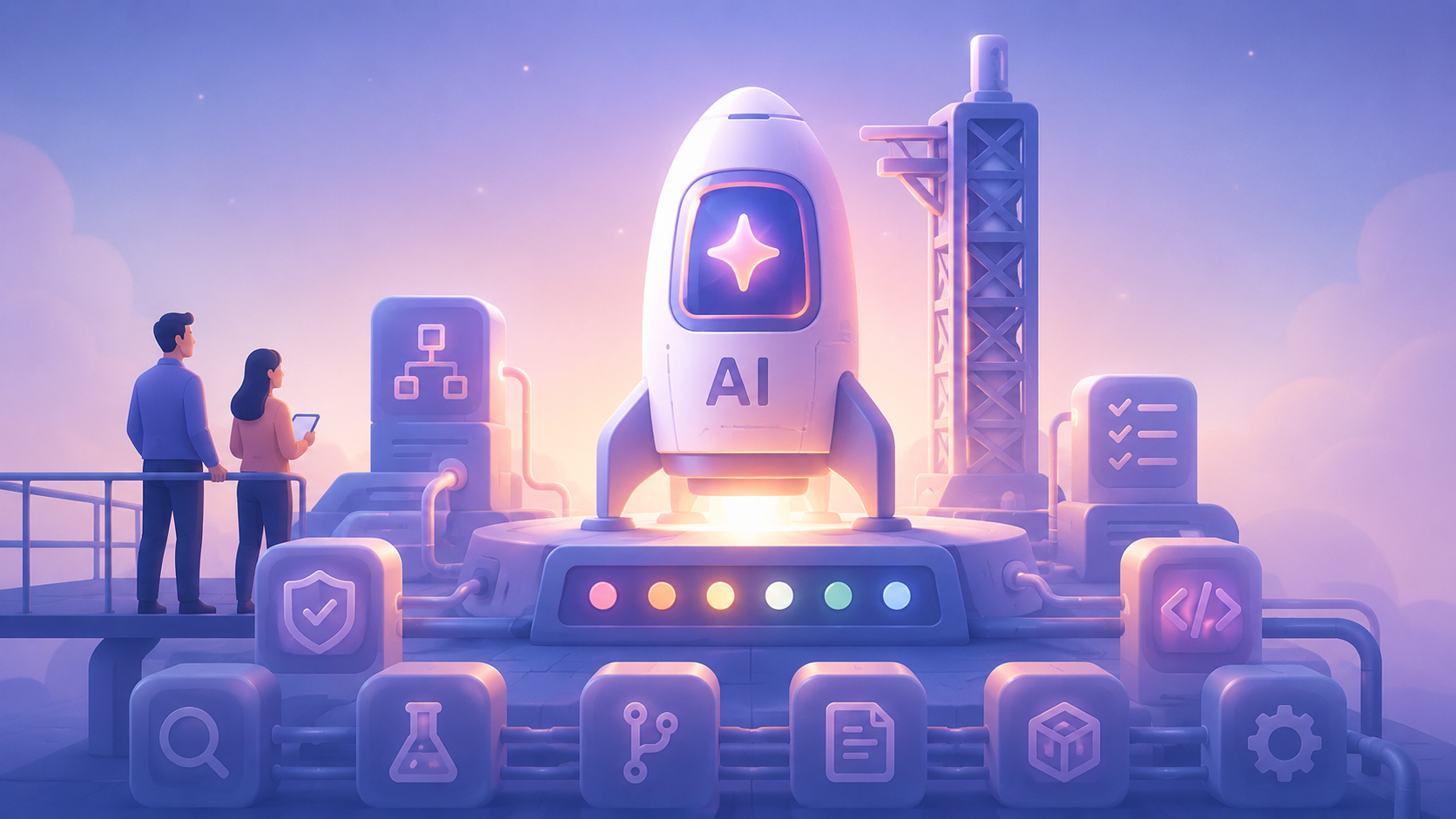
AI agents are moving quickly into software engineering.
They can generate code, open pull requests, debug issues, run tests, review changes, and orchestrate multi-step workflows. Work that once took days can now happen in hours.
For engineering leaders, the promise is obvious: faster prototyping, higher pull request velocity, shorter feedback loops, and more experimentation.
But many teams hit the same uncomfortable reality once adoption scales:
More agent activity does not automatically create better engineering performance.
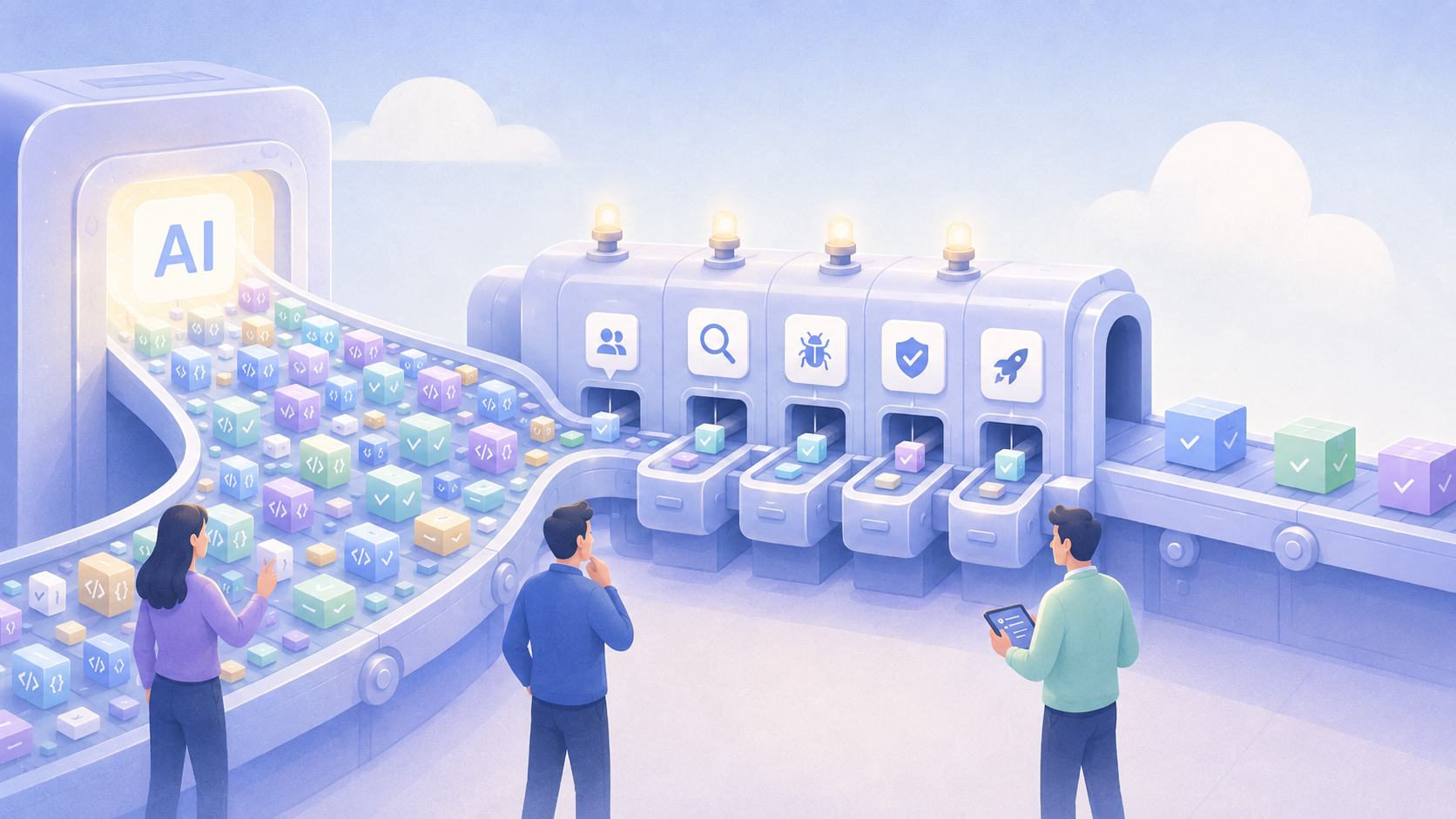
Agents can increase output. They can also increase review burden, rework, quality risk, and coordination overhead.
That is the difference between AI adoption and AI readiness.
Why adoption does not equal readiness
Most organizations have already rolled out tools like Copilot, Cursor, Claude, or other agentic workflows. At the individual level, the gains are often real. Developers move faster through repetitive tasks, generate drafts, write tests, and explore solutions more quickly.
But when you look at system-level outcomes, the picture becomes more complicated.
Lead time does not always improve. Change failure rate does not always decline. Rework can increase. Delivery predictability can stay flat. Senior engineers may spend more time reviewing, correcting, or contextualizing AI-generated work.
The reason is simple:
AI agents do not remove bottlenecks. They expose them.
- If review processes are already slow, agents create more work for review.
- If testing is weak, agents create more uncertainty.
- If documentation is outdated, agents make more inconsistent decisions.
- If ownership is unclear, agents increase coordination problems.
Without engineering readiness, AI does not scale cleanly. It moves the constraint somewhere else.
The 6 readiness dimensions that actually matter
Through our work with engineering organizations and our AI Readiness Assessment, we see six dimensions that determine whether agent adoption creates sustainable improvement or just more activity.
1. Delivery Flow Readiness
When agents increase output, delivery flow is the first place pressure shows up.
Review queues grow. Merge conflicts increase. Handoffs become slower. Large AI-generated changes become harder to validate. What looks like higher productivity upstream can become congestion downstream.
The key question is:
Can your delivery system absorb higher AI-generated volume without slowing down review, integration, and release?
If the answer is no, agents may create more movement without improving flow.
2. Quality and Validation Maturity
AI-generated code can look complete while still missing edge cases, introducing brittle assumptions, or creating hidden defects.
This makes validation critical.
Teams with strong automated testing, clear quality standards, reliable CI/CD, and fast feedback loops are better positioned to scale agentic work. Teams that rely heavily on manual review or inconsistent testing quickly run into trust issues.
The key question is:
Can you validate AI-generated work quickly and confidently?
Without strong validation, every agent contribution becomes another thing humans need to inspect in detail.
3. Knowledge and Context Readiness
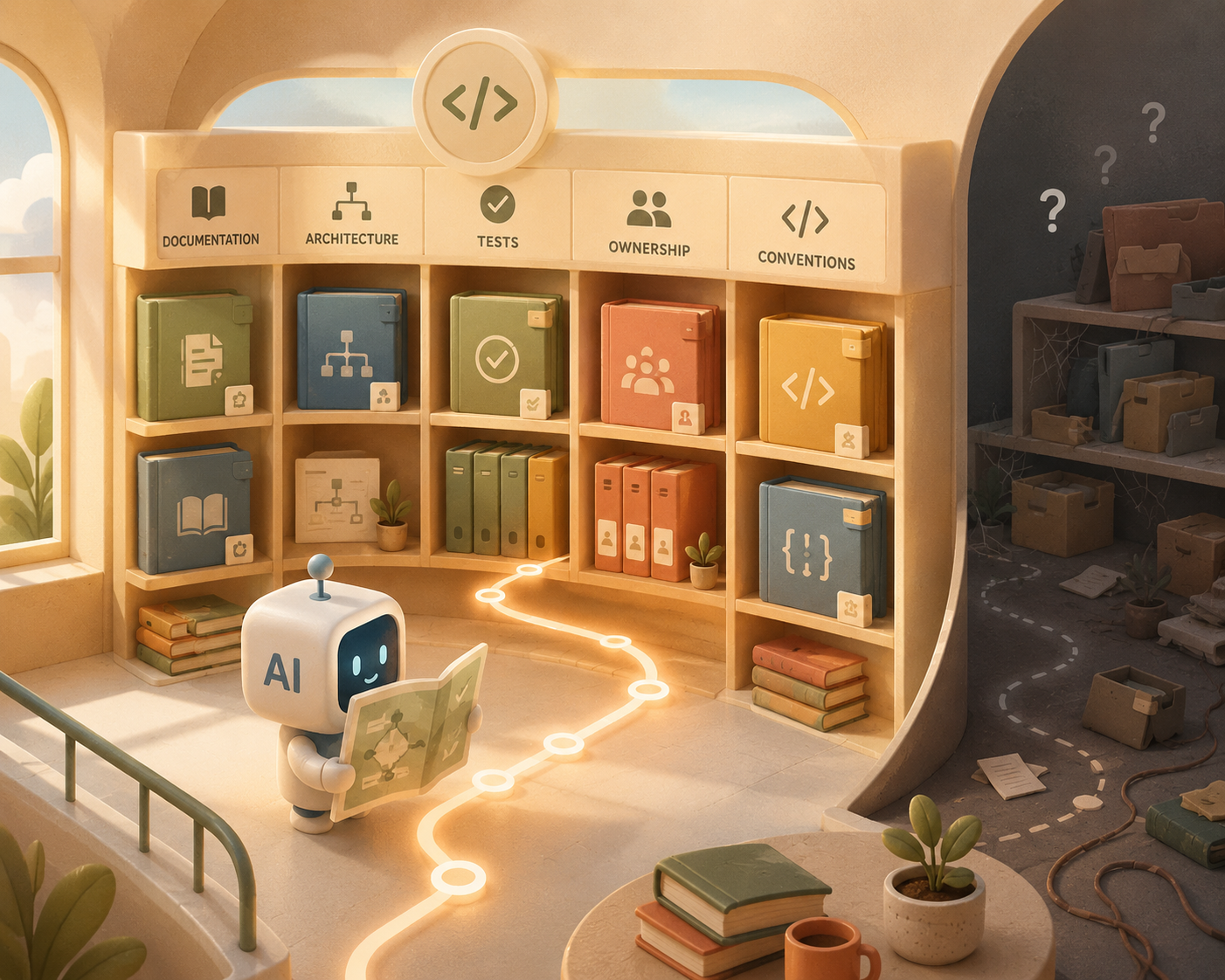
Agents are only as useful as the context they can access.
They need to understand the codebase, architecture, conventions, product logic, customer needs, and engineering standards. If that knowledge lives mostly in senior engineers' heads, Slack threads, old documents, or scattered pull request comments, agents will struggle to produce reliable work.
This is where many teams discover their knowledge debt.
The key question is:
Is your engineering knowledge clear enough for both humans and agents to use?
AI readiness is not only a tooling issue. It is also a knowledge management issue.
4. Automation and Governance Blockers
Scaling agents safely requires more than access to powerful models.
It requires the surrounding infrastructure to support controlled execution. That includes CI/CD maturity, sandboxing, secrets management, environment isolation, access controls, approval rules, and auditability.
Without these foundations, organizations either take unnecessary risk or keep humans in every approval loop.
Both limit scale.
The key question is:
Do you have the guardrails to let agents move faster without creating unacceptable risk?
Good governance does not mean slowing everything down. It means creating the conditions for safe speed.
5. Operational and Lifecycle Discipline
Agentic AI does not end when a pull request is opened.
Teams need to understand what happens after AI-assisted work reaches production. They need visibility into change quality, incident patterns, rollback needs, maintenance impact, and long-term technical debt.
They also need discipline around agent workflows themselves: what agents are used for, how prompts or workflows are versioned, how outputs are reviewed, and how performance is improved over time.
The key question is:
Can you monitor and improve agentic work across the full software lifecycle?
Without lifecycle discipline, teams may scale agent usage without understanding its long-term effects.
6. Cultural and Organizational Alignment
The hardest readiness gaps are often not technical.
Developers need to trust the system. Leaders need to set clear expectations. Teams need to know when to use agents, when not to, who owns the output, and how human judgment should be applied.
If the organization treats agents as magic productivity machines, adoption becomes shallow. If developers distrust them completely, adoption stalls. If ownership is unclear, accountability weakens.
The key question is:
Have you defined how humans and agents should work together?
The best teams treat agents as specialized contributors under human orchestration, not as replacements for engineering judgment.
The readiness roadmap: What high-performing teams do differently
The teams that succeed do not treat AI agent adoption as a tooling rollout.
They treat it as an operating model change.
They start by strengthening quality and validation, because you cannot scale what you cannot trust. They codify engineering knowledge so agents have better context. They improve delivery flow so increased output does not create downstream congestion. They define governance so teams can move faster without creating unmanaged risk.
Most importantly, they measure the system.
They do not only ask how many developers are using agents or how many pull requests agents helped create.
They ask:
Where is AI creating real leverage?
Where is it creating hidden debt?
Which bottlenecks are now limiting the return on AI adoption?
What should we improve first to scale agents safely and effectively?
That is the shift from using agents to becoming ready for agentic engineering.
How Deventura closes the readiness gap
This is the problem Deventura helps engineering leaders solve.
As AI agents become part of software delivery, leaders need more than adoption data. They need to understand how agent activity affects delivery performance, quality, efficiency, stability, and team behavior.
Deventura connects AI activity and agent contributions with software delivery data, giving leaders a clearer view of where AI is helping, where it is creating friction, and where the engineering system needs to mature.
Our AI Readiness Assessment helps teams identify:
- Which readiness gaps are limiting AI impact
- Where agent adoption is creating genuine leverage
- Where AI-generated work is increasing rework, risk, or bottlenecks
- Which improvements should be prioritized first
- How to scale agentic workflows with stronger evidence and less guesswork
The goal is not to slow AI adoption down.
The goal is to make sure faster movement translates into better engineering outcomes.
The path forward
AI agents will keep getting faster and more capable.
But the organizations that pull ahead will not be the ones that adopt agents the fastest. They will be the ones that build the strongest readiness around them.
That means better delivery flow, stronger validation, clearer engineering knowledge, practical governance, lifecycle visibility, and healthier human-agent collaboration.
Unchecked acceleration creates fragile velocity.
Engineering readiness turns agentic AI into durable advantage.